
June 2025 - Article
|
Battery diagnostics has been lagging and Cadex is making efforts to strengthen the weakest link, the battery. Statistics reveal that half of systems fail because of faded batteries, a weakness that the FDA in healthcare also realizes. Meanwhile every year over a million good batteries are discarded that causes high cost and environmental harm. Medical and military organizations have strict operational rules, but battery failure is often seen as an “Act of God” that cannot be solved for lack of diagnostic technology. We follow industrial requests for better battery diagnostics with technology that observes battery performance during routine services and displays the remaining useful life (RUL) of a battery to users and fleet supervisors. This service is available when connecting our diagnostic chargers to a host. |
 Backing batteries by Infrastructure
|
The groundwork of battery diagnostics rests on Minimal Operational Reserve Energy (MORE), a value that is set by the built-in Target Selector offered in most Cadex service devices. Defaulted to 80%, the target settings can be changed based to leftover charge at the end of day.
The leftover charge is made visible by the Fishbowl when connecting the charger to a PC and should be 10–20%. If in the low 10% range, increasing the setting provides extra energy; if above 20%, the value can be relaxed to extend battery service life.
|
An important addition to our new generation Cadex products is Cloud Analytics that gives confidence that each battery lasts a full day. Only strong batteries are kept in the system — weak packs are identified and replaced. This improves high battery reliability, reduces total cost of ownership and protects the environment. Cloud Analytics also supports the Matrix Library, a depository of matrices for Spectro™. This advanced batter test device departs from traditional load testing by modeling the battery against a matrix to assess capacity and fault conditions for improved safety. Test accuracy rests on the Matrix Integrity Level (MIL) that can be improved by scanning same-model batteries in different state-of-health conditions. Availability of matrices turns the Spectro Modular into an open test platform to service virtually any battery up to 300Ah and 48V by downloading the appropriate matrix into the open Spectro platform. Test time of the non-invasive service is 30 seconds, longer for large batteries that require low-frequency scanning. |
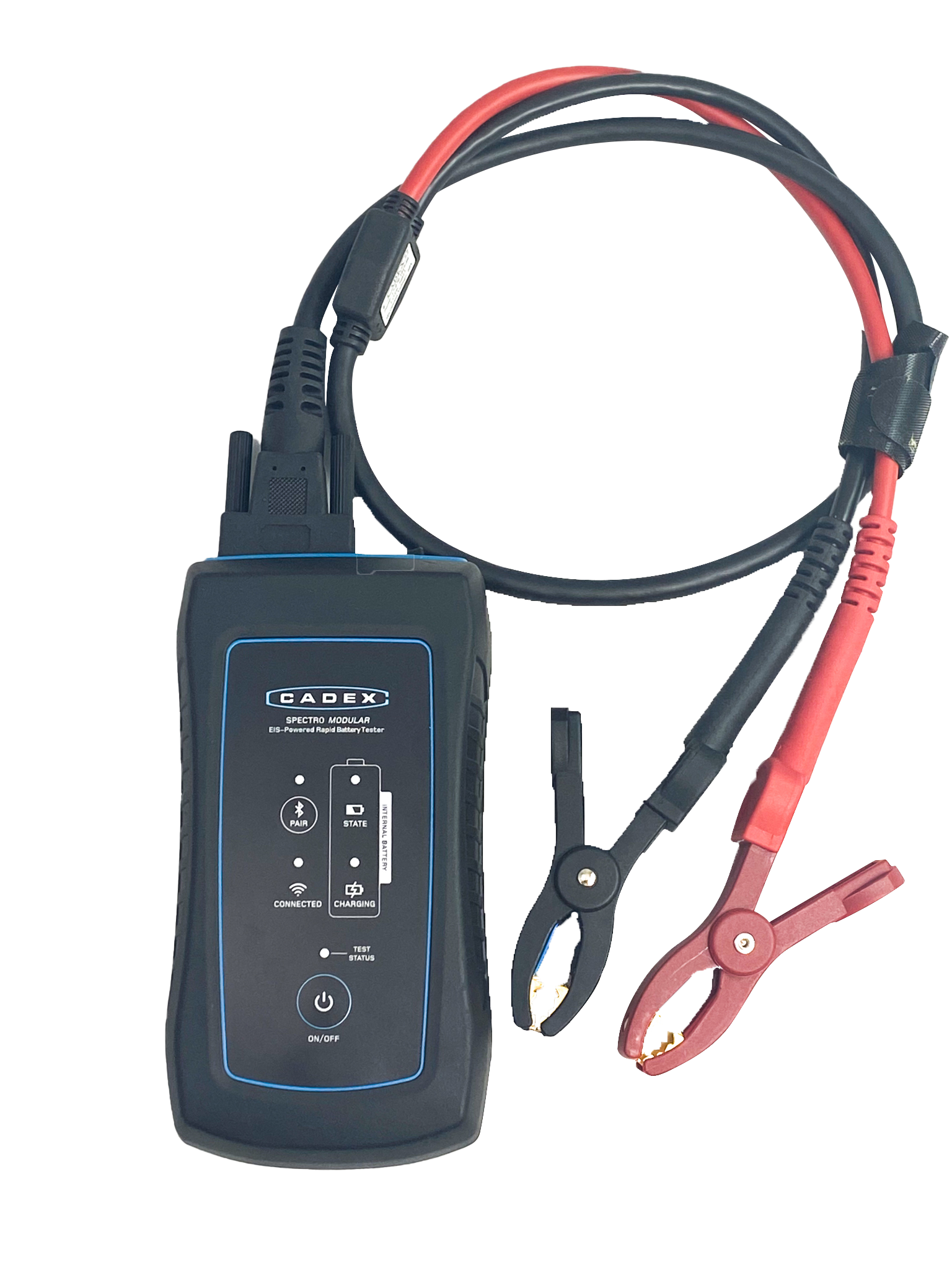 Spectro Modular
|
Typical Spectro applications are testing starter batteries to prevent getting stranded on fading capacity that goes mostly unnoticed. Special attention goes to heavy duty batteries with custom matrices to obtain test results that load testing cannot achieve. Furthermore, Spectro™ is especially beneficial in measuring capacity of wheeled mobility such as scissor lifts, floor sweepers, golf cars and wheelchairs. No battery will go out without knowing the capacity to assure a full day service.
The Spectro™ technology can also be incorporated in modern BMS to assess capacity and detect anomalies in UPS. A further service is reading the electrochemical evidence of batteries with the Spectro Explorer by optical evaluation of the Nyquist plot as part quality assurance.